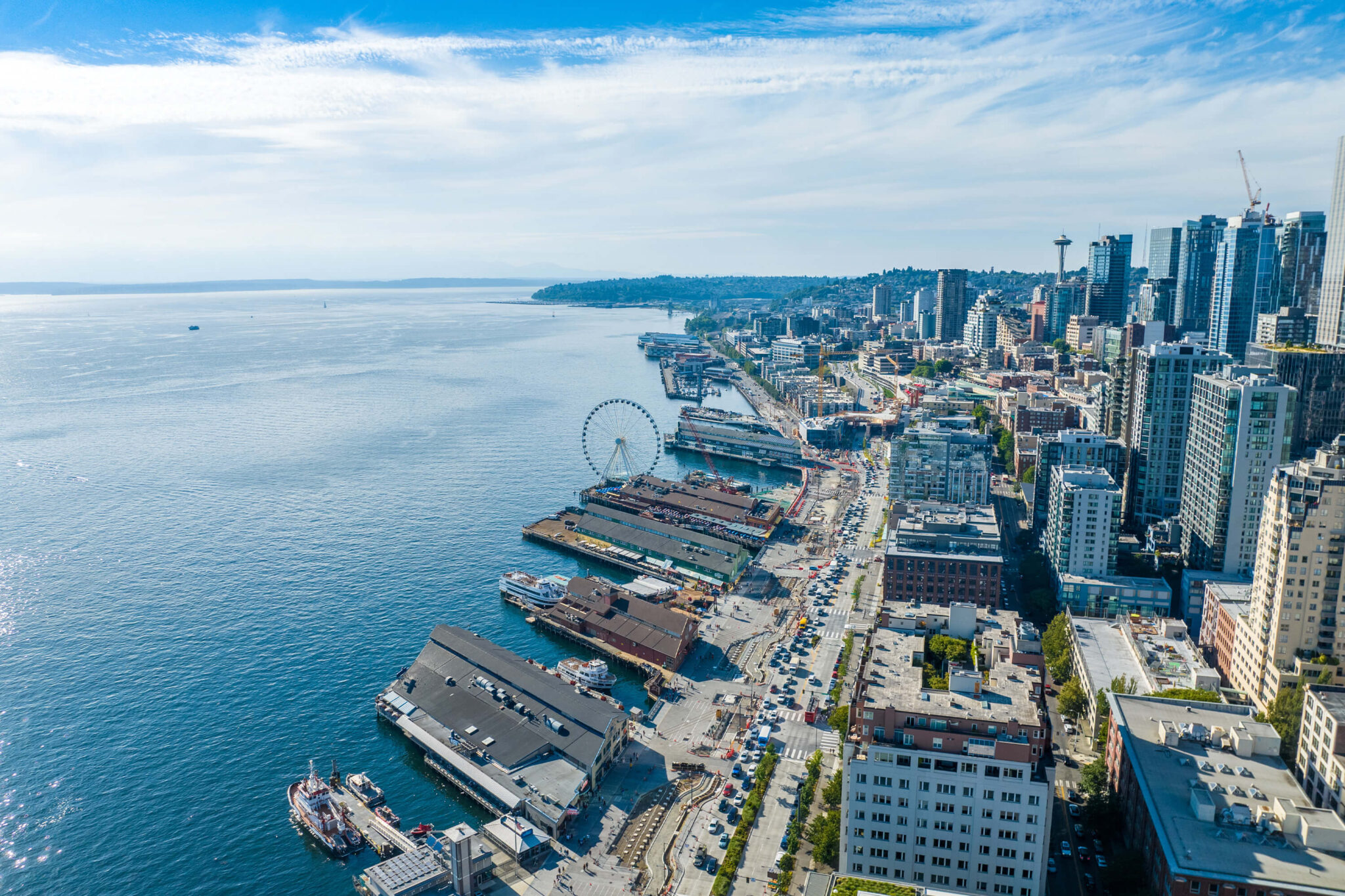
Seattle Waterfront
As part of the design team for Waterfront Park, my focus was on shaping how the site communicates its layered stories and making sure those ideas translated into real, buildable elements. Once the elevated highway came down and Seattle had a direct line back to its shoreline, we were tasked with designing the interpretive system and graphic identity for the new 20-acre park. A lot of the early work involved creating structure out of ambiguity. There was no set list of stories or designated locations, so we built the content framework from the ground up—tracking 30+ narratives, organizing research, and working with historians, cultural leaders, and Indigenous representatives to ensure accuracy and clarity. From there, we moved into the physical design. I modeled interpretive pieces and signage components in Blender to test scale, materials, and sightlines, and created a series of prototypes to study how content could live within handrails, planters, rebuilt piers, and circulation routes. As the graphic identity developed, we applied it across wayfinding and welcome signage, making sure typography, materials, and finishes aligned with the broader architectural vision. Much of the process was iterative—refining messages, adjusting layouts, coordinating with engineers, and ensuring every piece tied back to the core stories of the waterfront. Now fully open, Waterfront Park reconnects Seattle to its historic shoreline, and the interpretive system functions as a dispersed, open-air museum woven into daily movement through the site. Our work has since extended to nearby projects—from the Ocean Pavilion to Pioneer Square—continuing to reveal how the original shoreline shaped the city.
The work is crisp and gets to the point, while conveying extremely complex messages in a fun and exciting way.
The work is crisp and gets to the point, while conveying extremely complex messages in a fun and exciting way.
